
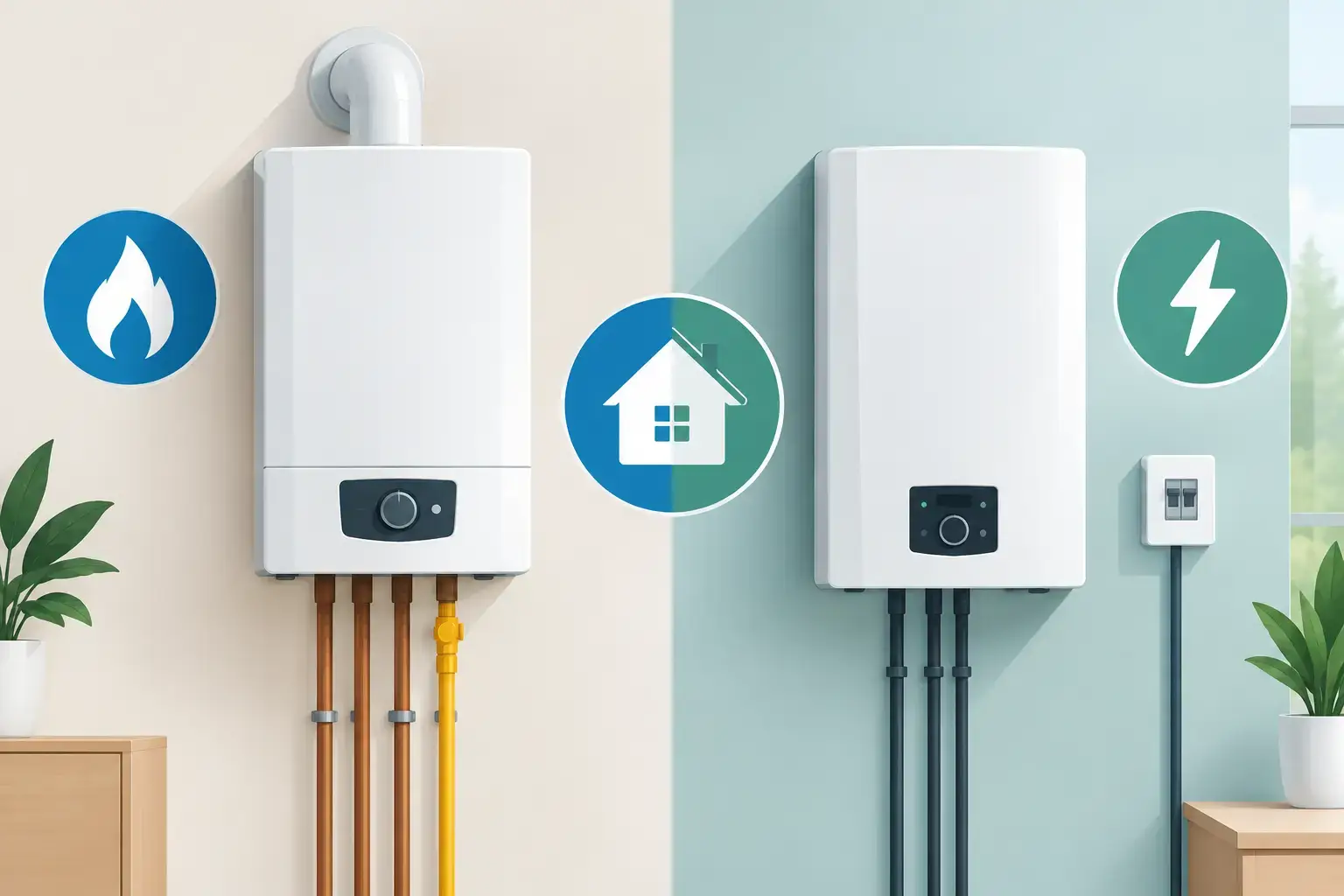
A boiler replacement is rarely just a like-for-like decision. When comparing gas boilers versus electric boilers, the right answer depends on your property’s heat demand, hot-water use, available services and plans for the years ahead. A compact flat with no gas supply has very different needs from a busy family home or commercial premises with several bathrooms.
Gas remains the familiar choice for many UK properties, but electric boilers can be a practical alternative in the right setting. The key is to look beyond the unit itself and assess how the whole heating and hot-water system will perform.
Gas boilers versus electric boilers: the main difference
A gas boiler burns mains gas to heat water for radiators, underfloor heating and, depending on the model, domestic hot water. Modern condensing boilers recover heat from their flue gases, helping them operate efficiently when correctly sized, installed and maintained.
An electric boiler uses electricity to heat water through electric elements. It has no combustion process, no flue and no need for a gas connection. Electric boilers are often compact and quiet, and they can work with conventional wet central-heating systems.
Both can provide reliable heating. The difference is how much heat your building needs, how you use hot water and what it costs to supply the energy.
Running costs need a realistic view
Electric boilers are highly efficient at the point of use: almost all the electricity they consume becomes heat. However, electricity usually costs more per unit than mains gas. For a typical home with a significant heating requirement, this can make an electric boiler more expensive to run than an efficient gas boiler.
That does not automatically rule out electric heating. If a property is very well insulated, small, used occasionally or has limited heat demand, the difference may be manageable. An electric boiler can also suit a home where fitting a gas supply and flue would be impractical or disproportionately costly.
Gas boilers generally offer lower day-to-day heating costs where mains gas is available, particularly for larger homes and properties with regular hot-water demand. Actual bills will still depend on energy tariffs, insulation, thermostat settings, radiator controls, household routines and the condition of the heating system.
For landlords and commercial operators, it is worth looking at the full cost over the expected life of the installation. That includes equipment, electrical or gas works, maintenance, likely repairs and the cost of downtime if the system fails.
Hot-water demand often decides the issue
A combi gas boiler can provide heating and hot water from one compact appliance, without a separate cylinder. It is a popular solution for smaller homes with one bathroom, although performance needs to be matched carefully to the incoming mains-water flow and household demand.
Electric boilers can provide hot water too, but they are commonly paired with a cylinder. This stores a set volume of heated water for baths, showers and taps. A cylinder can work very well for a household with multiple bathrooms, but it needs space and must be sized correctly. Once the stored hot water has been used, reheating can take time.
An electric combi boiler may be suitable for modest demand, but it is not usually the best answer for a large family home expecting several powerful showers at once. A proper survey should consider peak demand, not just the number of people living in the property.
Installation requirements and disruption
Gas boilers require a suitable flue route to safely remove combustion gases. The installation must be completed by a Gas Safe registered engineer, and the location must meet current regulations for ventilation, clearances and condensate drainage. Replacing an existing boiler in the same position is usually more straightforward than moving it or changing system type.
Electric boilers do not need a flue, which can make them attractive in some flats, listed buildings and properties without a suitable external wall. They also avoid the need for a gas meter and gas pipework. With fewer mechanical components, they are quiet in operation and typically need less routine maintenance than a gas boiler.
The electrical supply deserves close attention. An electric boiler can have a substantial power requirement. Some installations need upgrades to the consumer unit, dedicated circuits or even confirmation that the property’s incoming electricity supply has adequate capacity. This is especially relevant in commercial settings or where electric vehicle chargers, air conditioning and other high-load equipment are already in use.
Choosing electric simply because there is no flue can create problems if the electrical infrastructure has not been assessed first. Equally, assuming a gas boiler is the easy option can overlook the work needed to fit a compliant flue or improve old pipework and radiators.
Environmental considerations are changing
A gas boiler produces carbon emissions at the property because it burns fossil fuel. An electric boiler has no local combustion emissions, which can be beneficial for indoor air quality and removes the risk of carbon monoxide from the appliance itself.
Electricity is becoming cleaner as more low-carbon generation is added to the grid, but an electric boiler still uses considerable electricity during colder periods. It is therefore not automatically the lowest-carbon heating choice in every situation.
If reducing carbon emissions is the main priority, an air source heat pump may also be worth considering. Heat pumps do not generate heat in the same way as electric boilers. Instead, they move heat from outside air into the building, often producing several units of heat for each unit of electricity used. They need a suitable design, adequate space and a heating system that can operate effectively at lower water temperatures.
For some properties, a new gas boiler is a sensible short- to medium-term replacement. For others, investing in insulation, larger radiators, controls or a heat-pump-ready system may be a better long-term route. The right approach should reflect the building, budget and planned timescale rather than a one-size-fits-all recommendation.
Reliability, servicing and safety
Gas boilers should be serviced annually by a Gas Safe registered engineer. Regular servicing helps identify developing faults, checks safe combustion and supports efficient operation. Landlords must also meet their gas safety responsibilities for rented properties.
Electric boilers have no burner, flue or gas valve, so their routine servicing needs are generally lighter. They still need professional checks, particularly where there is a sealed system, cylinder, expansion vessel, pumps or controls. Water quality also matters. Sludge and debris in an older heating system can affect circulation and reduce performance regardless of the heat source.
No boiler type is maintenance-free. A well-designed installation, correct system cleaning, suitable inhibitor and properly set controls all contribute to reliable heating.
Which boiler suits your property?
A gas boiler is usually the stronger choice where mains gas is available, the property has medium to high heat demand and keeping running costs under control is a priority. It can also be a practical fit for homes that need fast, continuous hot water through a properly sized combi boiler.
An electric boiler may be suitable where there is no gas supply, flue options are restricted, the property is small and well insulated, or heating demand is low. It can also be a neat solution for certain extensions, small commercial units and homes used only occasionally, provided the electrical supply is adequate.
The system around the boiler matters just as much. A larger property may need zoning, a hot-water cylinder, upgraded radiators or improved controls. A smaller home may benefit more from accurate sizing than from buying the highest-output appliance available.
Before committing, ask for a site-specific assessment covering heat loss, hot-water demand, electrical capacity, flue requirements and likely running costs. For homeowners and property managers across Bedfordshire and the surrounding area, a qualified heating engineer can turn that information into a clear recommendation rather than a guess.
The best boiler is the one that delivers dependable warmth, sufficient hot water and costs you can live with – installed properly and supported by professional servicing throughout its life.