
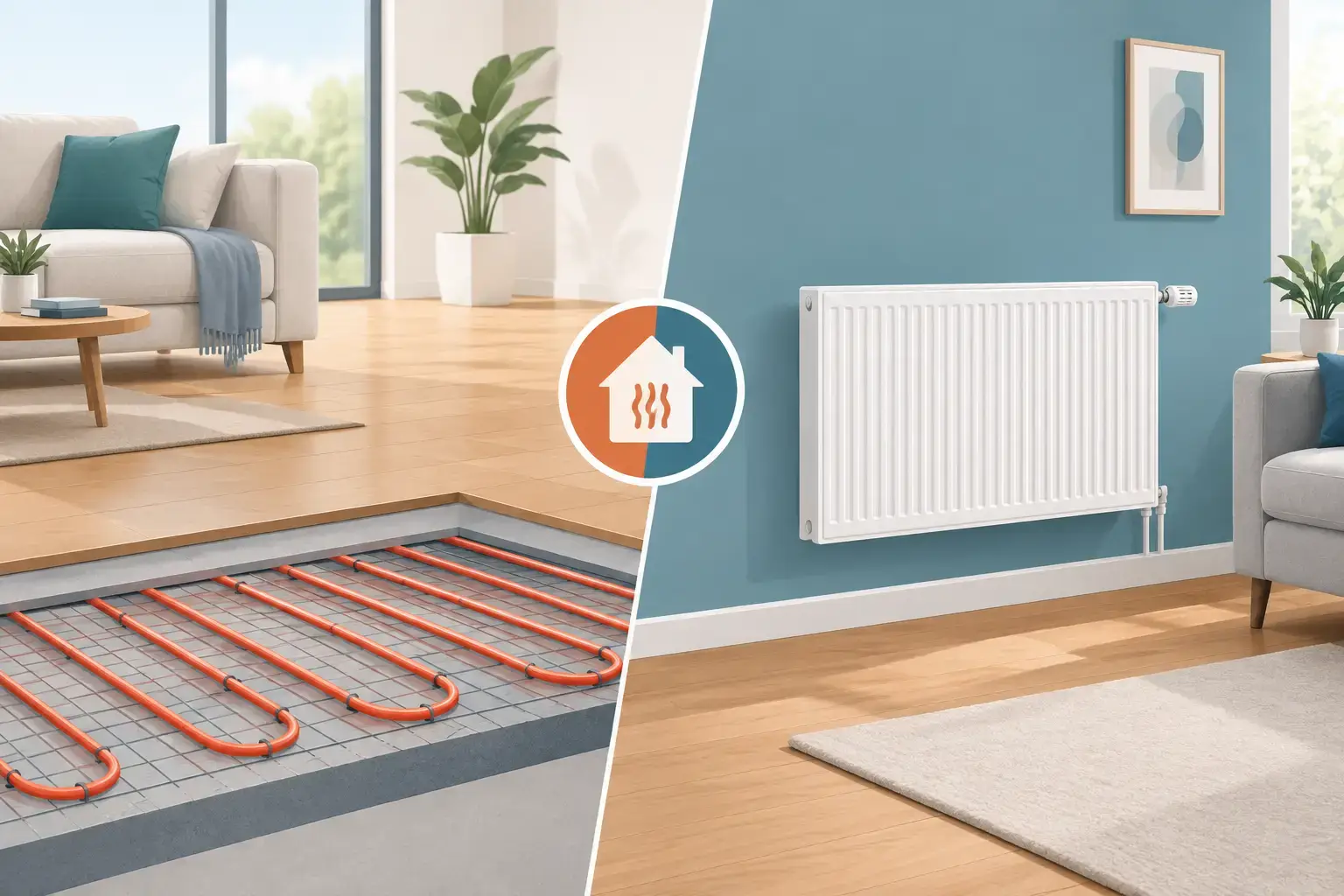
Replacing a heating system is one of those property decisions that affects every winter morning afterwards. When comparing underfloor heating vs radiators, the right answer is rarely about which system is universally better. It is about the building, the rooms you use, your budget, the heat source and how much disruption the project can reasonably involve.
Radiators remain a practical, responsive choice for many homes and commercial spaces. Underfloor heating can deliver excellent comfort and efficiency, particularly as part of a renovation or new build. A qualified heating engineer can assess the property properly before you commit to either route.
Underfloor Heating vs Radiators: The Main Difference
Radiators heat the air around them, creating convection currents that circulate warmth around the room. They heat up quickly and are easy to control room by room using thermostatic radiator valves or smart controls.
Underfloor heating works across a much larger surface area. Rather than concentrating heat at one point on the wall, it gently warms the floor and the lower part of the room. This creates a more even temperature, with fewer cold patches and no need for a hot radiator taking up wall space.
There are two main forms of underfloor heating. Electric systems use heating mats or cables and are often fitted in a single bathroom, kitchen or extension. Wet systems circulate warm water through pipework beneath the floor and are normally the better option for larger areas or whole-property heating.
The difference sounds simple, but installation requirements and running costs can vary significantly between the two.
Comfort and Day-to-Day Use
Underfloor heating is often chosen for the comfort it provides. A warm tiled bathroom floor on a cold morning is an obvious benefit, but the bigger advantage is the consistency of the heat. Because warmth rises gradually from the floor, rooms can feel comfortable at a slightly lower thermostat setting than they would with radiators.
It is particularly well suited to open-plan kitchens, extensions and bathrooms, where large floor areas and hard finishes such as tile, stone or engineered flooring can otherwise feel cool. It also frees up wall space for furniture, storage or glazing.
Radiators are more responsive. If you come home to a cold house and want rapid warmth, radiators will generally provide it sooner. Underfloor heating has more thermal mass, especially when pipework sits within a screed floor, so it can take longer to heat up and cool down. This is not necessarily a disadvantage, but it does mean controls need to be set up around your daily routine rather than constantly turned up and down.
For rooms used occasionally, such as spare bedrooms, meeting rooms or parts of a commercial building with changing occupancy, radiators can be easier to manage. A well-designed system can overcome some of this with zoning, but it needs careful planning from the outset.
Installation Cost and Disruption
This is usually where the decision becomes clearer. Replacing or adding radiators is comparatively straightforward where suitable pipework and a working boiler are already in place. There may be some decorating afterwards, but the project is typically less disruptive and less expensive than fitting wet underfloor heating throughout an existing property.
A wet underfloor system often requires floors to be lifted, insulation to be installed and new pipework to be laid. Floor heights may increase, which can affect doors, skirting boards, kitchen units and thresholds. In a full renovation or new build, these details can be designed in from the beginning. Retrofitting it into a finished home is possible, but needs an honest assessment of the practical work involved.
Low-profile underfloor systems can reduce the increase in floor level and may be suitable for refurbishment projects. However, they are not a shortcut around proper preparation. Insulation beneath the system is essential. Without it, a portion of the heat can be lost downwards rather than warming the room efficiently.
Electric underfloor heating is less intrusive to install in a small area and can make good sense in a bathroom renovation. It should not automatically be seen as the cheapest system to run across a large house, however. Electricity prices and the total area being heated need to be considered carefully.
Running Costs and Efficiency
Underfloor heating is often described as more efficient, but the full picture depends on the heat source and system design. Wet underfloor heating can operate at lower water temperatures than traditional radiators because it uses a much larger surface area. That makes it a strong match for a heat pump, which performs best when supplying lower-temperature heating.
It can also work efficiently with a modern condensing boiler, provided the system is designed, balanced and controlled correctly. Simply fitting underfloor heating does not guarantee lower bills if the property has poor insulation, the controls are used poorly or the system has been installed without a proper heat-loss calculation.
Radiators can also be efficient. Modern larger radiators, including low-temperature models, can work well with heat pumps and allow a boiler to run more effectively at lower flow temperatures. This can be a sensible upgrade for a property where lifting floors is not realistic.
Running costs are influenced by more than the heat emitters. Insulation, draught-proofing, glazing, boiler or heat pump performance, hot water demand and heating controls all matter. Before choosing between systems, it is worth addressing obvious heat loss. There is little value in upgrading the heating if the building is still losing warmth through an uninsulated loft or poorly sealed doors.
Which Flooring Works Best?
Tiles and stone are excellent partners for underfloor heating because they conduct heat well and retain it for longer. Polished concrete can also perform well in the right setting. Engineered wood, vinyl and many carpets may be suitable, but the flooring manufacturer must confirm that the product is compatible with underfloor heating and state the permitted surface temperature.
Thick carpets and dense underlay can reduce heat transfer. That does not rule them out completely, but the combined thermal resistance needs to be checked. Timber flooring requires particular care because excessive temperature changes can lead to movement, gaps or damage.
Radiators are less dependent on floor finishes. This makes them more flexible if you expect to change carpets or redecorate regularly, or if a commercial premises may be reconfigured over time.
Maintenance, Repairs and Reliability
Both systems can be dependable when correctly installed and maintained. Radiator systems are familiar to most homeowners and easier to alter later. Individual radiators can be replaced, moved or upgraded with relatively limited work. Common issues such as cold spots, trapped air or a sticking valve are usually straightforward for a heating engineer to investigate.
Wet underfloor heating pipework is designed to be long-lasting and should not need regular attention. The manifold, pump, actuators and controls are the components most likely to require servicing or adjustment. A properly designed system should include accessible manifolds and clear zoning arrangements, rather than hiding all key components behind finished surfaces.
If a fault develops beneath a finished floor, diagnosis can be more involved than with an exposed radiator system. This is one reason why quality installation, pressure testing, commissioning and accurate records matter so much. Choosing a qualified, experienced installer is more valuable than selecting the cheapest quote.
When Radiators Are the Better Choice
Radiators are often the most sensible option where you are improving an existing heating system without undertaking major building work. They suit homes that need fast heat-up times, rooms that are used irregularly and properties with suspended timber floors where a full retrofit would be disruptive.
They are also a strong choice for landlords and property managers who need a proven, serviceable system with manageable repair costs. Upgrading old radiators, adding effective controls and ensuring the system is cleaned and balanced can make a noticeable difference to comfort without the cost of lifting floors.
In many properties, the best solution is not all or nothing. Underfloor heating may be ideal for a new kitchen extension, bathroom or ground-floor living space, while radiators remain the practical choice upstairs.
When Underfloor Heating Is Worth It
Underfloor heating is most attractive when floors are already being replaced, a property is being extended or a new build is being planned. It can deliver a clean finish, stable comfort and excellent compatibility with low-temperature heating systems.
For larger open-plan rooms, it can avoid the challenge of finding wall space for several radiators. In bathrooms, it can help dry floors more quickly and remove the need to squeeze a radiator into a compact layout, although a heated towel rail may still be useful for towels and quick bursts of warmth.
The key is to view it as part of the wider heating design, not a stand-alone feature. Heat-loss calculations, insulation levels, floor construction, manifold location and controls should all be agreed before installation begins.
A heating survey gives you the confidence to make a decision based on your property rather than a showroom display. Whether you choose radiators, underfloor heating or a combination of both, the most comfortable and economical result comes from a system designed properly, installed neatly and maintained by trusted, fully qualified engineers.