
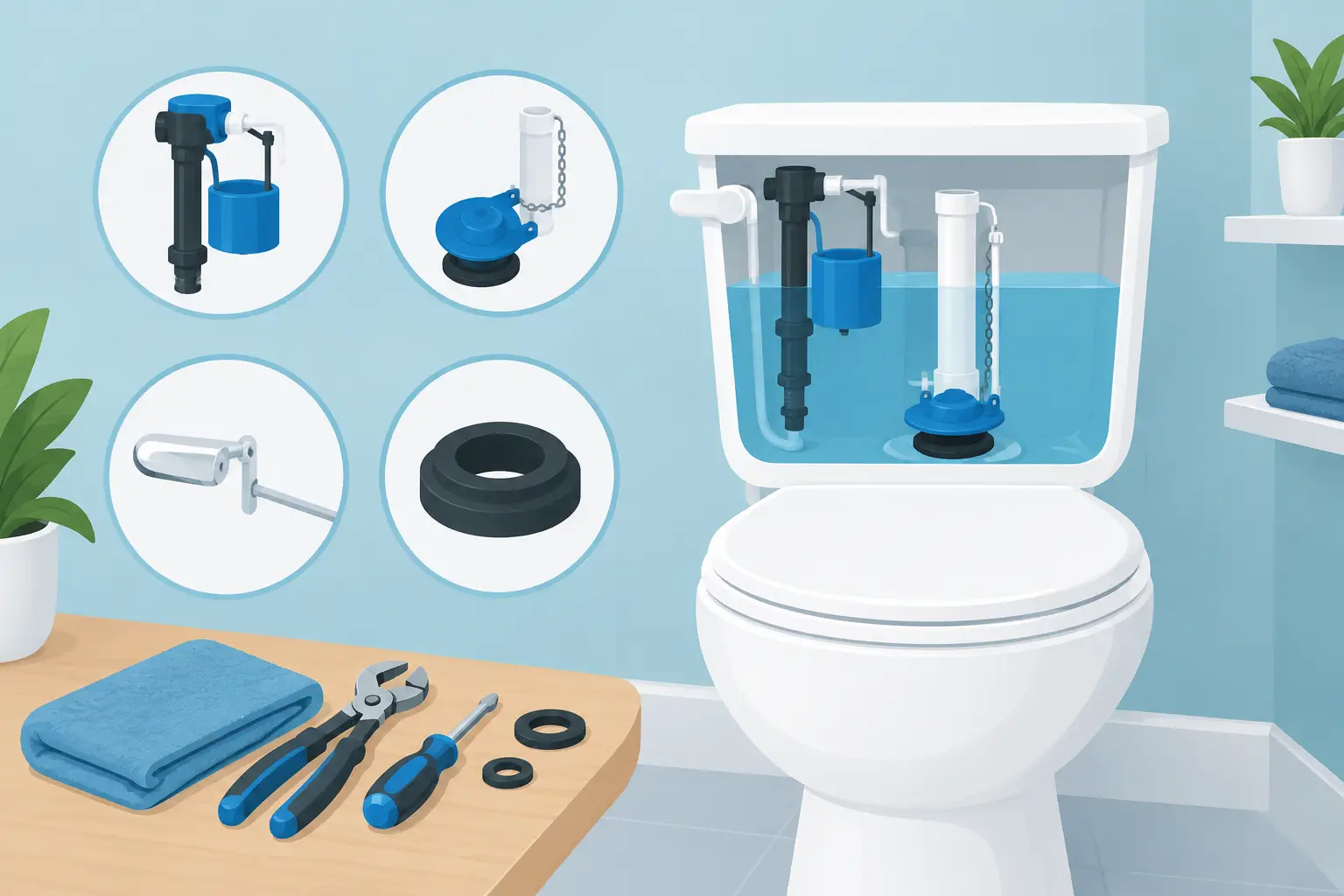
A toilet that keeps running after flushing can waste a surprising amount of water, while a cistern that will not refill can quickly make a bathroom unusable. The right toilet cistern repair options depend on what has failed inside the unit, how old the fittings are and whether the cistern is easy to access. In many cases, a small replacement part restores reliable flushing. In others, replacing the full internal mechanism is the more sensible long-term repair.
Start by identifying the cistern fault
Before choosing a repair, look at the symptom. Modern toilet cisterns contain a fill valve, flush valve or siphon, push-button or handle mechanism, seals and overflow arrangement. A problem with any of these parts can affect how the toilet fills, flushes or holds water.
Water trickling into the pan long after flushing usually points to a worn flush valve seal or diaphragm. Water constantly flowing into the overflow is more likely to be a fill valve issue. If the toilet takes a long time to refill, the inlet valve may be restricted by debris or simply reaching the end of its working life.
A weak flush can result from a partial blockage, an incorrect water level or a worn siphon diaphragm. Where the button feels loose, sticks or does nothing, the problem may be with the cable, pneumatic actuator or button assembly rather than the main flushing mechanism.
The cistern should be isolated before any work begins. Most toilets have a small isolation valve on the water supply pipe, usually operated with a flat-head screwdriver. If there is no local valve, the water supply may need to be turned off at the stopcock. Flush the toilet afterwards to empty the cistern as far as possible.
Toilet cistern repair options for a running toilet
A continuously running toilet is one of the most common plumbing faults. It is also one worth dealing with promptly, particularly in rental properties or commercial washrooms where unnecessary water use can go unnoticed for weeks.
Replace the flush valve seal
On many dual-flush cisterns, the most likely cause is a perished rubber seal at the base of the flush valve. Over time, limescale, wear and movement prevent the seal from sitting tightly against its outlet. Water then escapes steadily into the toilet pan.
Replacing the seal is often the most cost-effective repair where the valve body is otherwise in good condition. The correct seal must match the make and model of the valve. A seal that is slightly too large, too thin or poorly seated can leave the same problem unresolved.
Renew the complete flush valve
If the valve is old, brittle, difficult to dismantle or has already had repeated repairs, replacing the whole flush valve can be better value. This means removing the cistern fittings and fitting a compatible new valve, then adjusting the flush volume and checking for leaks.
A complete replacement is particularly worthwhile when older components are no longer readily available. It also avoids the frustration of replacing one worn part only for another part of the same mechanism to fail shortly afterwards.
Repair or replace a siphon
Traditional lever-operated toilets commonly use a siphon rather than a modern flush valve. Inside the siphon is a diaphragm that can split with age, causing a weak flush or a toilet that will not flush at all. Replacing the diaphragm can solve the issue, but access often requires the cistern to be disconnected from the pan.
For an older cistern, fitting a new siphon may be the more reliable route. A qualified plumber can also assess whether the existing arrangement meets current water regulations and whether an upgrade would improve flushing performance.
Fixing a cistern that will not fill properly
If the cistern remains empty or fills very slowly, attention turns to the fill valve, sometimes called the inlet valve or ball valve. Older cisterns may have a brass arm and float, while newer models usually use a compact plastic valve with an adjustable float.
A slow fill can sometimes be caused by sediment caught in the valve filter. This is more common in areas with hard water. Cleaning the filter may help, provided the valve is sound and the internal components are not badly worn.
Where the cistern does not stop filling, the float level may need adjustment. However, adjustment is not a lasting solution if the valve is sticking or failing to close consistently. Replacing the fill valve is generally a straightforward and dependable repair, and modern universal valves can suit many standard cisterns.
The replacement needs to be correctly set. If the water level is too high, it will run into the overflow. Too low, and the flush may lack power. The fill valve must also be compatible with the cistern’s water entry point, which may be at the bottom or side.
When buttons, handles and cables are the problem
A non-working flush does not always mean the main internal valve has failed. Push-button toilets can develop issues with snapped cables, disconnected rods or pneumatic tubes that have come loose. Concealed cisterns behind a wall or furniture panel need additional care, as access is usually through the flush plate opening.
If a button sticks, do not force it. This can crack the button plate or damage the actuator behind it. The correct repair may be as simple as refitting an actuator rod, but some mechanisms require a matching manufacturer part.
Lever handles can loosen, corrode or disconnect from the siphon linkage. A replacement handle may be sufficient, although a worn siphon diaphragm should be checked at the same time. It makes little sense to replace the handle alone if the flushing mechanism itself is unreliable.
Repair versus replacing the whole cistern
Most toilet cistern problems can be repaired without replacing the toilet. This is usually less disruptive and more affordable than fitting a complete new WC. Even so, there are situations where a full replacement is sensible.
Consider a new cistern or toilet where the ceramic is cracked, fixing bolts are corroded beyond safe removal, internal parts are obsolete, or the cistern has had multiple leaks and repairs. A new unit may also be appropriate during a bathroom refurbishment, when a concealed cistern, reduced flush volume or different style is wanted.
For landlords and commercial property managers, standardising on readily available fittings can make future maintenance easier. The best choice is not always the cheapest component on the day. It is the option that provides a dependable flush, avoids repeat visits and keeps water consumption under control.
When to call a qualified plumber
Some cistern repairs are within reach of a confident homeowner, especially replacing a readily accessible seal or button. However, call a plumber if the isolation valve does not work, the cistern is concealed, there is a leak around the base or back of the toilet, or the fault is unclear.
Leaks outside the cistern can damage flooring, ceilings and surrounding finishes. A plumber can identify whether the issue comes from the inlet connection, flush pipe, cistern-to-pan bolts, pan connector or a cracked component. This diagnosis matters because water seen around the toilet is not always caused by the cistern itself.
Professional help is also worthwhile where parts need matching accurately, particularly with branded concealed systems. LCA Maintenance can assess the fault, explain the practical repair choices and carry out the work with transparent pricing and minimal disruption.
A reliable repair starts with the right part
Toilet fittings are not all interchangeable, even when they look similar. Before ordering parts, check the cistern manufacturer, valve type, water entry position and flush mechanism. A clear photograph of the inside of the cistern, including any model markings, can help identify what is needed.
Once repaired, test the toilet several times. Check that it fills to the correct level, stops cleanly, delivers a full flush and leaves no water running into the pan. A quiet cistern that fills, flushes and shuts off properly is a small thing, but it is one less disruption in a busy home or property.