
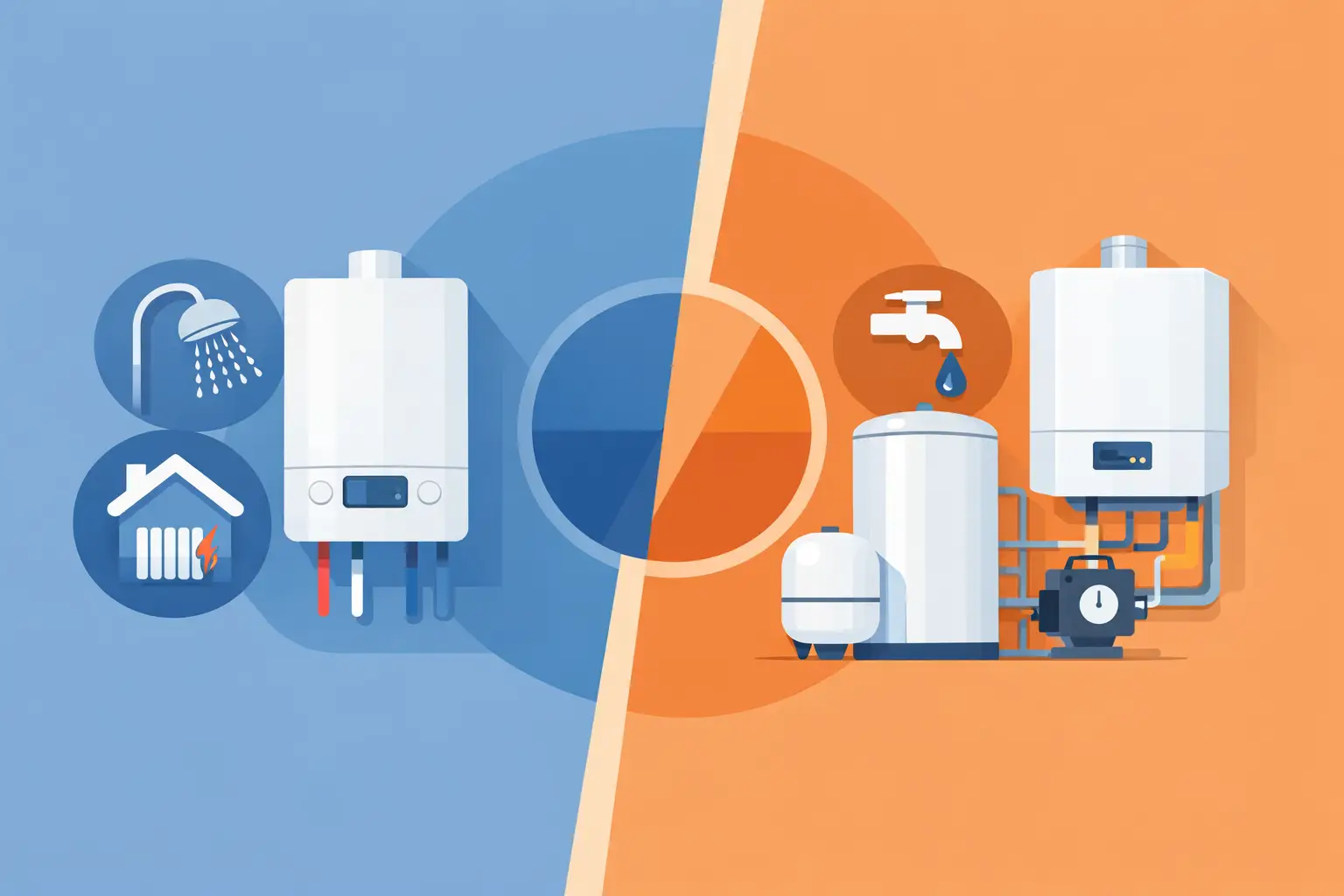
Replacing a boiler is one of those jobs that looks simple on paper until you start weighing up hot water demand, water pressure, storage space and future running costs. When people compare combi boiler vs system boiler options, they are usually trying to answer one practical question – which one will work best for the way the property is actually used?
The right answer depends less on what is most popular and more on how many bathrooms you have, how often people use hot water at the same time, and whether your home has the space for additional components. A boiler that suits a two-bedroom flat may be a poor fit for a busy family house. That is why this choice is worth getting right before installation day.
Combi boiler vs system boiler: the main difference
A combi boiler heats water directly from the mains as and when you need it. It does not rely on a separate hot water cylinder, which makes it a compact option for smaller properties or homes where cupboard space is limited. You turn on a tap or shower, and the boiler fires up to produce hot water instantly.
A system boiler works differently. It heats your central heating directly, but it also stores hot water in a separate cylinder for later use. Many of the main heating components are built into the boiler itself, so the overall set-up is tidier than a traditional regular boiler system, but it still needs more room than a combi.
For many homeowners and landlords, that distinction is the starting point. If saving space is the priority, a combi often appeals. If the property needs to supply multiple bathrooms reliably, a system boiler is often the stronger option.
When a combi boiler makes more sense
Combi boilers are popular for good reason. They are compact, efficient and generally well suited to smaller homes with modest hot water demand. If you have one bathroom, limited loft or airing cupboard space, and no need to run several hot water outlets at once, a combi can be a very practical choice.
Because there is no hot water cylinder, you only heat the water you use. That can help with efficiency, especially in households where demand is fairly predictable and not especially heavy. Installation can also be more straightforward in the right property, particularly when replacing an older combi with a newer model.
There is another benefit people often like – you do not have to wait for a cylinder to reheat. Hot water is produced on demand, so there is no risk of using up the stored supply after a couple of showers.
That said, a combi has limits. If two showers and a kitchen tap are all calling for hot water at the same time, performance can drop. The boiler can only deliver so much flow at once. In a busy household, that can become frustrating quite quickly.
When a system boiler is the better fit
A system boiler tends to suit larger homes, properties with more than one bathroom, and households where several people may need hot water in a short period. Because hot water is stored in a cylinder, the system can supply multiple outlets more effectively than many combi boilers.
This can make a real difference during the morning rush. If one person is showering, another is running a bath and someone else is using the kitchen sink, a system boiler is generally better equipped to cope. For family homes, that extra capacity can outweigh the space needed for the cylinder.
System boilers are also a sensible option where mains water pressure is good and there is enough room for the cylinder. They can work very well in properties where comfort and convenience matter more than saving every bit of storage space.
The trade-off is that once the stored hot water is used, you may need to wait for the cylinder to heat again. Modern systems can be set up efficiently, but the stored supply is not endless. That is worth bearing in mind if demand is especially high.
Hot water performance matters more than boiler size alone
One of the most common mistakes is assuming that a more powerful boiler automatically means better performance. Boiler output is important, but in the combi boiler vs system boiler decision, the pattern of hot water use matters just as much.
A high-output combi might serve a one-bathroom property very well. In a larger home, though, even a powerful combi can struggle if several outlets are used at once. A system boiler with a correctly sized cylinder may deliver a better day-to-day experience, even if the headline figures look less impressive to a non-specialist.
This is why a proper assessment matters. Number of bedrooms alone does not tell the full story. The number of bathrooms, the incoming mains pressure, the size of the household and the timing of demand all need to be considered.
Space, layout and installation practicalities
Boiler choice is not only about performance. It is also about what the property can sensibly accommodate.
A combi boiler is often chosen where space is tight. Flats, smaller terraced homes and some rental properties benefit from having no hot water cylinder and fewer visible components. If the aim is to free up airing cupboard space or simplify the system layout, a combi is attractive.
A system boiler needs room for the hot water cylinder, so it is not always the easiest option in compact homes. However, in larger houses this is less of an issue, and the added storage can be a worthwhile compromise for better hot water availability.
Installation complexity can vary as well. Swapping like for like is usually easier than changing boiler type completely. Moving from a regular boiler to a combi or system boiler may involve pipework alterations, removal of old tanks or changes to controls. That does not make it a bad idea, but it should be factored into the cost and planning.
Running costs and efficiency
Both combi and system boilers can be highly efficient when properly specified and installed. The idea that one type is always cheaper to run than the other is too simplistic.
A combi can reduce wasted energy because it only heats water when required. That can work well for smaller households or homes where demand is low to moderate. If there is no need to keep a cylinder of hot water ready, there is less standing heat loss.
A system boiler can still be very efficient, especially with modern controls, good insulation on the cylinder and a household that actually benefits from stored hot water. In some homes, the practical performance of a system boiler makes it the more sensible long-term choice even if the combi looks slightly neater on paper.
The best approach is to look at efficiency alongside usage habits. A technically efficient boiler that does not suit the household will rarely feel like good value.
Which boiler is better for landlords and property managers?
For landlords, the decision often comes down to balancing tenant expectations, property size and maintenance practicality. In smaller rental properties with one bathroom, a combi boiler is often the straightforward option. It saves space, keeps the system simple and gives tenants on-demand hot water.
In larger lets, HMOs or family homes with heavier demand, a system boiler may prevent complaints about poor hot water performance. If several occupants are likely to be using bathrooms around the same time, capacity becomes more important than compactness.
Property managers also need to consider lifecycle planning. A well-matched system tends to create fewer day-to-day issues than one chosen purely on upfront price.
How to decide between a combi and a system boiler
If your home has one bathroom, limited storage space and average hot water demand, a combi boiler will often be the sensible choice. If your property has multiple bathrooms, a larger household or frequent simultaneous hot water use, a system boiler is usually better placed to cope.
If you are unsure, that is entirely normal. Boiler selection should be based on a proper survey rather than guesswork or online averages. An experienced heating engineer will look at your current set-up, the property layout, your water pressure and how the building is used before recommending the right system.
For households across places such as Milton Keynes, Luton or Cambridge, where housing stock ranges from compact newer builds to larger family homes, there is no one-size-fits-all answer. The best boiler is the one that matches the property and the people using it.
A reliable heating system should make daily life easier, not force you to work around its limits. If you choose with that in mind, you are far more likely to be happy with the result years after the installation is finished.