
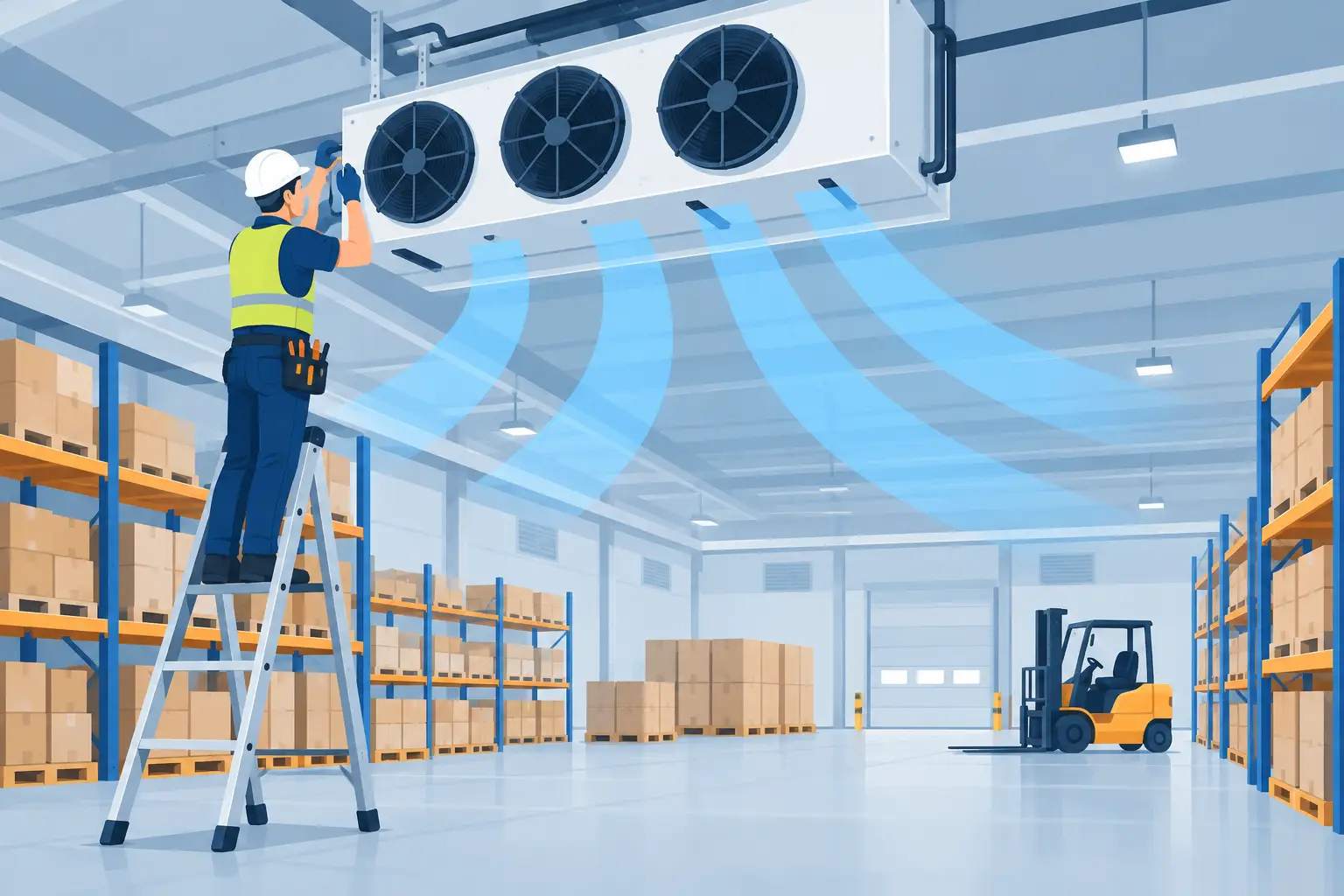
A warehouse that becomes uncomfortably hot is not simply a staff welfare issue. High temperatures can slow picking and packing, affect concentration, damage temperature-sensitive stock and place extra strain on equipment. A well-planned warehouse cooling installation gives operators better control over these risks without committing to oversized equipment and unnecessary running costs.
For warehouses, distribution centres and production spaces, the right answer is rarely as simple as fitting a few wall-mounted air conditioning units. The building’s layout, heat sources, working patterns and ventilation all affect the design. A professional survey is the starting point for a system that performs reliably when it matters most.
Start with the heat load, not the unit size
Warehouses vary enormously. A high-bay storage facility with loading doors open for much of the day will behave very differently from a sealed fulfilment area with automated machinery and a large number of staff. Selecting cooling equipment from floor area alone can leave parts of the building too warm while other areas are cooled unnecessarily.
A competent assessment considers the total heat entering and being generated within the space. This includes solar gain through rooflights and cladding, the size and orientation of glazing, roof insulation, lighting, forklifts, battery charging areas, IT equipment, machinery and the number of people working on site. Frequent vehicle movements and open roller shutters can also introduce substantial warm air during summer.
Ceiling height matters just as much. Warm air naturally rises, so a tall warehouse may show a significant temperature difference between floor level and the roof. In some buildings, air circulation or destratification fans can make a meaningful improvement alongside mechanical cooling. In others, especially where stock, people or processes need a consistent temperature, dedicated air conditioning is the more suitable route.
The aim is not necessarily to make every cubic metre of a large warehouse feel like an office. It is to create a safe, workable environment in the zones where people and products need it.
Choosing the right warehouse cooling installation
There is no single system that suits every commercial site. The best option depends on whether cooling is required throughout the building, in specific work areas, or for a separate temperature-controlled room.
Zoned air conditioning for occupied areas
For packing benches, offices within warehouses, dispatch areas and enclosed work zones, commercial split or multi-split air conditioning can offer precise control. These systems allow separate areas to be set independently, which avoids cooling unoccupied space unnecessarily.
Variable refrigerant flow systems may be appropriate for larger or more complex buildings with several zones. They can serve multiple indoor units from a shared outdoor system and are often a practical choice where cooling needs differ across departments. The trade-off is that design, pipework routes and controls need careful planning from the outset.
Industrial cooling for open warehouse spaces
Large open spaces may call for industrial air conditioning, evaporative cooling, air handling equipment or a combination of solutions. Evaporative cooling can be economical in the right conditions and works by introducing cooled, fresh air. However, it is not suitable for every setting. Its effectiveness is influenced by humidity, and it may not be the preferred choice where strict temperature control or low moisture levels are required.
Ducted systems and air handling units can distribute conditioned air more evenly across bigger areas. They require space for ductwork and access for maintenance, so early consideration is helpful, particularly in busy facilities where racking, fire services and electrical containment already occupy ceiling space.
Targeted cooling where the problem is localised
Sometimes the most cost-effective solution is not whole-building cooling. Battery charging rooms, server cupboards, quality-control areas and heat-producing production lines may need their own dedicated cooling. Targeting these hotspots can protect equipment and improve working conditions without increasing the load on a wider system.
A site survey should identify whether localised cooling, wider air movement or a full building solution will achieve the required result. This avoids spending capital on equipment that does not address the real source of discomfort.
Design around operations, stock and access
Cooling equipment has to work around the way your warehouse operates. Indoor units must not obstruct racking, loading routes, crane runs, emergency signage or fire safety systems. Outdoor condensers need a secure location with suitable airflow, service access and protection from accidental damage by vehicles or goods handling equipment.
Air distribution also deserves close attention. Blowing cold air directly across packing stations can make staff uncomfortable, while poor air throw can leave distant zones warm. Unit positioning, diffuser selection and fan speed should be designed for the building rather than chosen as an afterthought.
For sites with sensitive goods, temperature requirements should be clearly defined before installation begins. Electronics, pharmaceuticals, food products, adhesives and certain raw materials can all have different storage tolerances. If a particular range must be maintained, the system should include appropriate controls, monitoring and alarms rather than relying on occasional manual checks.
Noise is another practical consideration. A system that is acceptable in a high-activity dispatch space may be distracting in a warehouse office or staff welfare area. Good design balances cooling performance with the day-to-day comfort of the people using the building.
Controls make the difference to running costs
Even an efficient air conditioning system can be expensive to operate if it runs for long periods in empty areas or fights against open doors. Controls should match the site’s actual working pattern.
Time schedules can reduce waste outside operational hours, while zoning allows only occupied sections to be cooled. Temperature sensors should be positioned away from direct sunlight, warm machinery and supply air streams, as these can give misleading readings. In some cases, door contacts, occupancy sensing or integration with a building management system may be worthwhile.
Setpoints need to be realistic. Driving temperatures down too far increases energy use and can create an uncomfortable contrast between indoor and outdoor conditions. The appropriate target depends on the activity, clothing requirements, heat generated by the process and the goods being stored.
Where a warehouse is heated in winter, a heat pump-based air conditioning system can also provide efficient heating in shoulder seasons or specific zones. This can be a useful additional benefit, although it should be assessed alongside the existing heating arrangement rather than assumed to replace it entirely.
Installation planning should minimise disruption
A commercial installation should be planned around stock movements, shift patterns and safety requirements. Depending on the site, works may need to be phased, carried out outside peak trading hours or coordinated with other contractors.
Before work begins, agree access routes, lifting arrangements, isolation requirements and safe working areas. Ceiling-level installation may require mobile elevated work platforms, while outdoor equipment can need concrete bases, brackets or protective barriers. Refrigerant pipework, electrical supplies and condensate drainage should be routed neatly and protected where necessary.
The electrical capacity of the site must also be checked. Larger cooling systems may require new circuits, local isolators or distribution-board upgrades. Addressing this during design is far easier than discovering a limitation once equipment is ready to be commissioned.
For commercial properties, the installer should also consider relevant building requirements, F-Gas obligations and manufacturer installation standards. Using fully qualified engineers helps ensure the system is correctly installed, leak tested, commissioned and documented.
Commissioning is where performance is proven
Installation is not complete when the units first switch on. Commissioning confirms that the system is operating safely and delivering the intended capacity. Refrigerant charge, airflow, drainage, electrical readings, controls and temperature response should all be checked.
Staff should be shown how to use the controls correctly, including which settings to avoid and what to do if an alarm is displayed. This prevents common issues such as units being left in the wrong mode, set to unrealistic temperatures or switched off in areas that need stable conditions.
For facilities managers, clear handover information is valuable. Keep details of the equipment model numbers, maintenance requirements, control settings and service records in an accessible location. This makes future servicing and fault diagnosis quicker and helps maintain continuity when personnel change.
Protect your investment with planned maintenance
Warehouse cooling equipment works hard during warm weather, often in dusty environments with long operating hours. Filters can clog, condensate drains can block and outdoor coils can become restricted by debris. Left untreated, these issues reduce capacity, increase energy use and may lead to avoidable breakdowns during the hottest period of the year.
Planned maintenance typically includes cleaning filters and coils, checking drains, inspecting electrical connections, confirming refrigerant circuit performance and testing controls. The right frequency depends on the environment and use. A clean warehouse office may need less frequent attention than a busy industrial facility with airborne dust, cardboard fibres or vehicle activity.
If your operation relies on controlled temperatures, consider what happens when a system fails. Remote monitoring, alarm notifications and contingency arrangements can be sensible where product loss or operational downtime would be costly.
A properly designed cooling system should feel like part of the building, not a daily concern for your team. For warehouse operators across Bedfordshire and the wider South East, taking the time to assess the space, the workload and the future use of the site will lead to a more dependable installation and more comfortable working conditions when temperatures rise.