
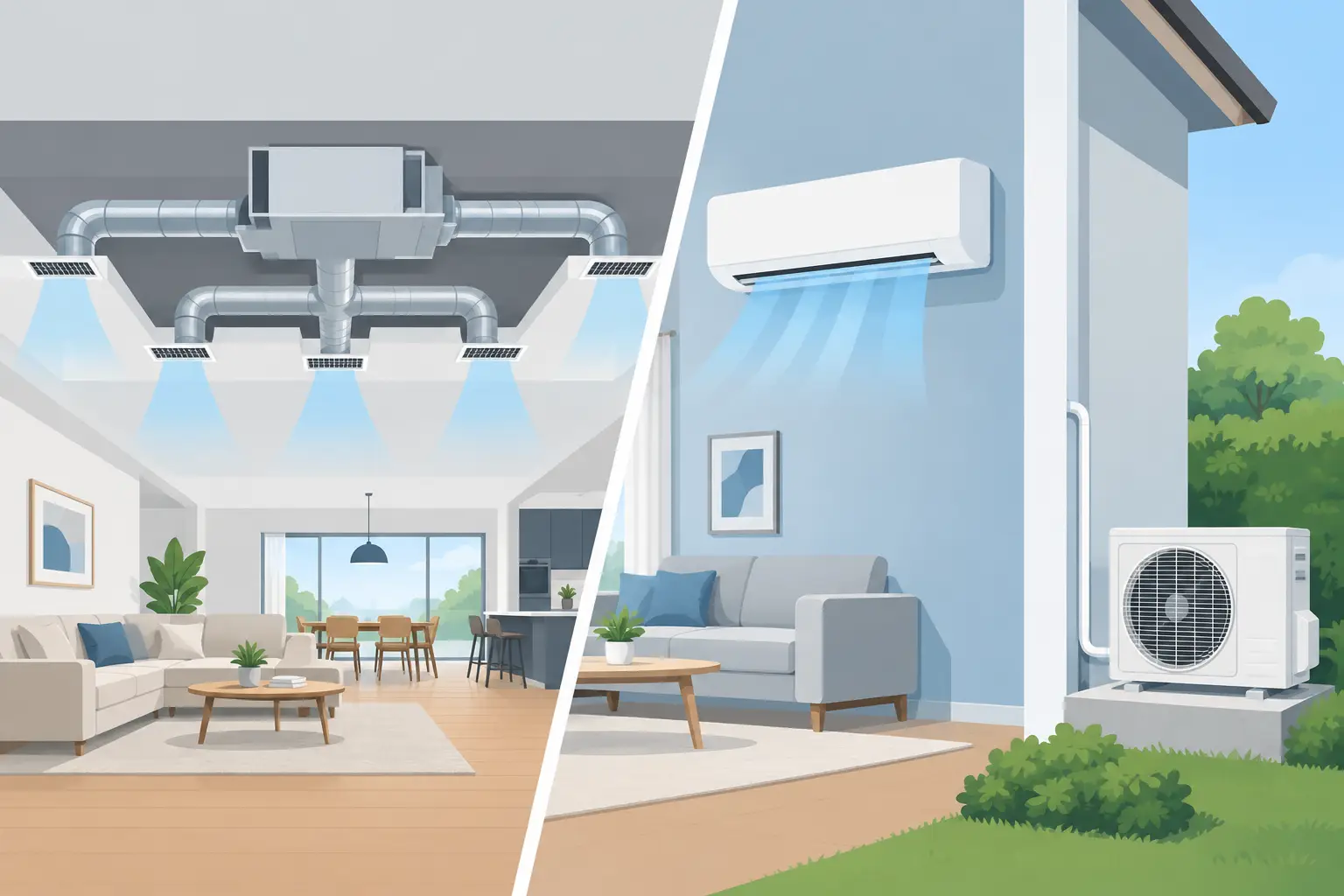
A single hot upstairs bedroom, a busy south-facing office or a whole building that never seems to cool evenly can all lead to the same question: ducted versus split air conditioning – which system is the better investment? The right answer depends less on the size of the unit and more on how you use the property, how many rooms need cooling and what the building can accommodate.
Both systems can provide effective cooling and, on many models, efficient heating too. But they distribute conditioned air differently, have different installation requirements and suit very different priorities. A qualified survey is the sensible first step, particularly where bedrooms, commercial workspaces or a refurbishment project are involved.
Ducted versus split air conditioning: the core difference
A split air conditioning system has an outdoor condenser connected to one or more indoor units. The indoor units are usually wall-mounted, although ceiling cassettes, floor-standing units and concealed units are also available. Each indoor unit serves a defined room or zone.
A ducted system uses a concealed indoor fan coil, normally located in a ceiling void, loft space or dedicated plant area. Conditioned air travels through ductwork to discreet grilles in each room, with return-air grilles drawing air back to the unit. One system can therefore cool or heat several rooms without visible wall-mounted units in each space.
This distinction affects almost every practical consideration, from budget and building work to day-to-day control. Neither option is automatically better. A split system is often the most direct solution for a handful of rooms, while ducted air conditioning can be the cleaner, more integrated choice for a larger project.
When split air conditioning makes the most sense
Split systems are popular in homes because they are flexible and relatively straightforward to install. If the priority is cooling a main bedroom, loft conversion, home office or living room, a single split unit can provide targeted comfort without major alterations to the property.
For multiple rooms, a multi-split system may connect several indoor units to one outdoor unit. Each room can generally have its own temperature setting, making it useful where occupants have different comfort preferences. A bedroom can be kept cooler overnight, for example, without running the unit in an unused lounge.
The installation route is usually less invasive than a ducted design. Refrigerant pipework, condensate drainage and electrical supplies still need to be planned properly, but there is no requirement to run bulky ductwork through the building. This matters in finished properties with limited ceiling voids or where minimising disruption is essential.
There are trade-offs. Indoor wall units remain visible, and a multi-room layout may require several units across the property. Airflow is highly effective within the room served, but it is not a substitute for a designed whole-house system where even temperatures throughout the property are the goal.
For small offices, shops and individual commercial rooms, split systems can also offer a practical balance of cost, control and speed of installation. The system can be sized around the room’s heat load, considering sun exposure, glazing, people, IT equipment and operating hours rather than relying on a rough estimate.
Where ducted air conditioning earns its place
Ducted air conditioning is usually considered where appearance, whole-property comfort and quiet operation carry more weight than the lowest installation cost. With the main equipment concealed, only the supply and return grilles are visible. This can work particularly well in high-specification renovations, larger homes, hospitality settings and professional workplaces.
A carefully designed ducted system can supply multiple rooms with consistent, gentle airflow. Grilles can be positioned to suit the room layout, and zoning controls can allow different parts of the building to operate independently. That makes a difference in properties with separate sleeping, living and working areas.
It can also be the right choice for commercial premises where a collection of visible wall units would not suit the interior or would be difficult to manage. Offices, meeting rooms and retail spaces often benefit from an integrated approach, especially during a fit-out when ceilings are already open and services can be coordinated.
The main consideration is space. Ductwork requires adequate ceiling or loft voids, and the system needs access for future inspection and maintenance. Retrofitting ducted air conditioning into a finished property can be possible, but it is more involved than fitting a split unit and may require boxing, lowered ceilings or carefully planned routes through the building.
Cost: look beyond the first quotation
Split air conditioning generally has the lower upfront cost, particularly for one or two rooms. Fewer materials, less labour and reduced building work usually make the price easier to manage. A multi-split arrangement will cost more than a single split, but can still compare favourably with a full ducted installation in many existing homes.
Ducted systems have a higher initial outlay because the design, ductwork, grilles, controls and installation time are more extensive. The total can vary significantly according to the building layout, access, number of zones and whether the work is being completed alongside a renovation.
However, purchase price alone is not the full picture. A poorly sized split system will struggle to maintain comfort and may use more energy than necessary. Equally, a ducted system that cools empty areas unnecessarily can waste energy if it has not been designed with practical zoning and controls.
Ask for a clear scope of works that explains what is included: equipment, pipework or ductwork routes, electrical work, condensate drainage, making good, controls, commissioning and any ongoing maintenance requirements. Transparent pricing makes comparisons more meaningful and reduces the risk of unexpected extras once work begins.
Energy efficiency and running costs
Modern air conditioning systems can be very efficient, especially inverter-driven equipment that adjusts output rather than repeatedly switching at full power. In heating mode, many air-to-air systems can deliver useful warmth with lower energy use than direct electric heaters, although suitability will depend on the wider heating arrangement and how the property is occupied.
With split systems, room-by-room control can help keep running costs focused on occupied spaces. The key is sensible use: select a comfortable set temperature rather than an extreme one, keep doors and windows closed while operating, and clean filters as recommended.
Ducted systems can be efficient too, but their performance relies on good design. Correctly sized, insulated and sealed ducts are essential. Zoning is equally valuable, allowing areas to be conditioned only when needed. A system serving a large home or commercial floorplate should be designed around actual use patterns, not simply the number of rooms.
Neither system can compensate for poor insulation, excessive solar gain or badly fitted windows. During a survey, these factors should be discussed because they influence the cooling load and the size of equipment required.
Noise, appearance and everyday comfort
Noise is a common concern, especially in bedrooms. A quality split unit installed and maintained correctly can be very quiet at lower fan speeds, but there will still be an indoor unit in the room. Placement matters – it should not blow directly onto the bed or workstation, and it should be positioned to distribute air properly.
Ducted systems can feel less noticeable in day-to-day use because the fan coil is remote from the room and the air is delivered through grilles. That said, poor duct design or insufficient grille sizing can create air noise. This is why design quality matters as much as the brand of equipment selected.
Aesthetically, ducted systems offer the most discreet finish. Split systems offer more visible control over individual rooms and may be the preferable option where each space has a different schedule. The best choice often comes down to whether you value a hidden installation or simple independent room control.
Installation and maintenance requirements
Both systems should be installed by suitably qualified engineers. Refrigerant handling, electrical connections, condensate drainage and commissioning all need to be completed correctly for safety, efficiency and reliability. Commercial systems may also have additional inspection, record-keeping and compliance obligations depending on refrigerant charge and site requirements.
Split units need their filters cleaned regularly and should receive planned professional maintenance. Outdoor units must be kept clear of leaves, debris and restricted airflow. For ducted systems, filters, condensate components, fan sections and accessible ductwork require routine attention. Access panels should never be treated as an afterthought during installation.
For landlords and businesses, planned maintenance is particularly valuable. It helps identify drainage blockages, reduced airflow, refrigerant issues and worn components before a system fails during a heatwave or a busy trading period.
Choosing the right system for your property
A split system is often the sensible option if you want to cool one or several specific rooms, have limited ceiling space or need a cost-conscious retrofit. It offers responsive room control and can usually be installed with less disruption.
A ducted system may be the stronger long-term choice if you are renovating, fitting out a commercial space or want discreet whole-property comfort. It requires more planning and budget, but can deliver a refined finish and consistent climate control across several rooms.
Before deciding, arrange a site survey that considers the building fabric, room sizes, occupancy, electrical capacity, external-unit position, drainage and future servicing access. LCA Maintenance can help homeowners and commercial clients assess these practical details and specify a system that suits the property rather than forcing a one-size-fits-all answer.
The most worthwhile air conditioning installation is not necessarily the largest or most concealed one. It is the system that keeps the spaces you use comfortable, operates efficiently and remains straightforward to maintain for years to come.