
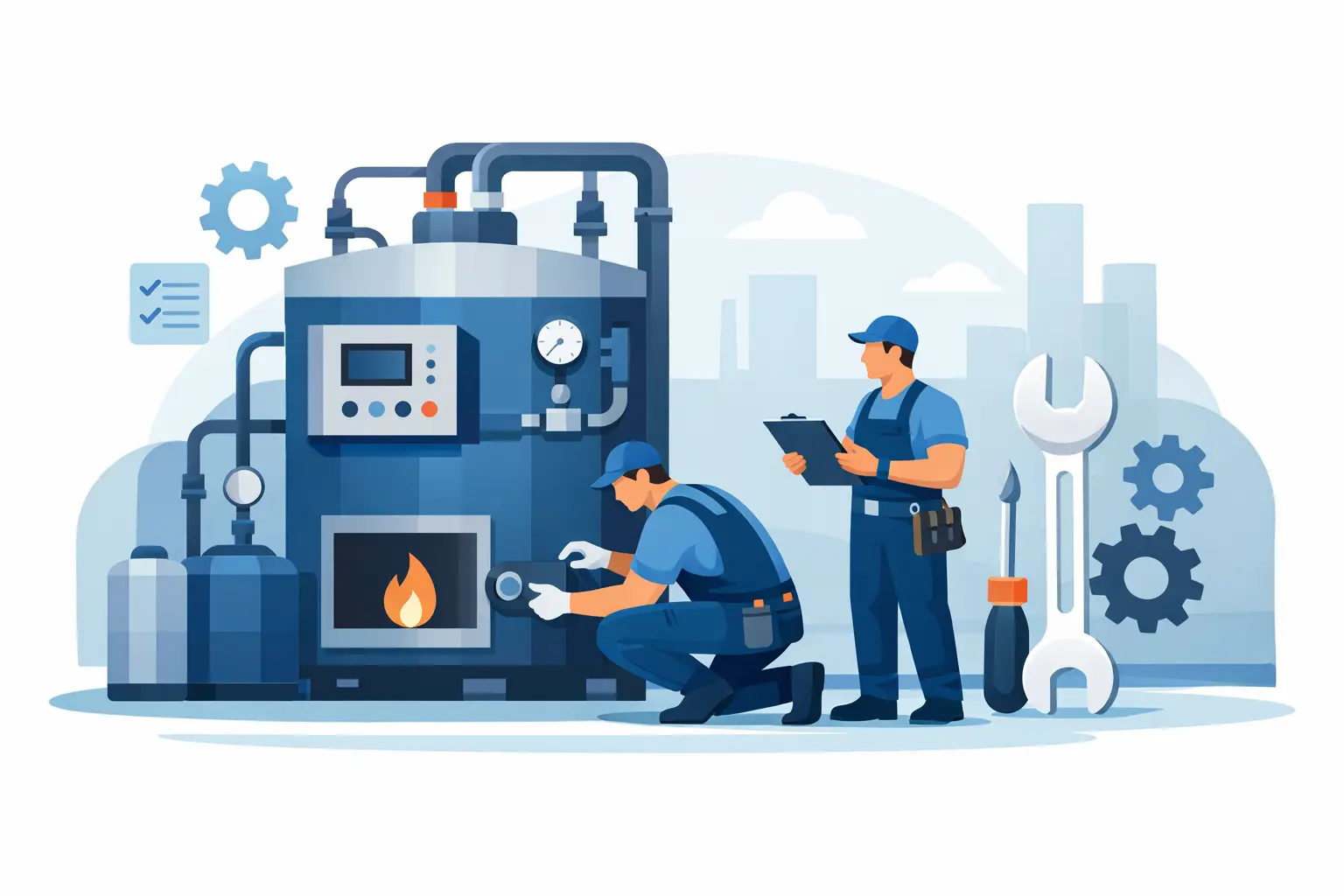
A cold office, closed kitchen or unavailable hot water supply can disrupt far more than comfort. It can stop trading, affect staff welfare and create costly pressure for a facilities team. This guide to commercial boiler maintenance explains how planned care protects your building, budget and compliance responsibilities before a small fault turns into an urgent call-out.
Commercial boiler maintenance is not simply an annual service. A reliable approach combines routine site checks, professional servicing, water treatment, accurate records and a clear response plan when performance changes. The right schedule depends on the boiler type, building use, operating hours and the consequences of downtime.
Why commercial boiler maintenance needs a planned approach
A commercial heating system works harder than most domestic installations. It may heat several zones, supply hot water to washrooms or kitchens, run for extended periods and connect to controls, pumps, pressurisation equipment and building management systems. A fault in any one part can make the whole system less efficient or unavailable.
Planned maintenance gives engineers the opportunity to spot wear before it becomes failure. A declining pump, intermittent sensor, blocked filter or incorrect system pressure may not trigger an immediate shutdown, but it can increase energy use and place unnecessary strain on the boiler.
For landlords, business owners and duty holders, there is also a safety and compliance case. Gas appliances and associated pipework must be maintained in a safe condition. Annual checks and servicing by a suitably qualified, Gas Safe registered engineer are central to meeting those responsibilities, but the records should be supported by ongoing maintenance evidence rather than treated as a once-a-year exercise.
Start with a clear maintenance plan
The most useful maintenance plan is built around the site, not a generic checklist. A small office with a single condensing boiler has different needs from a school, care setting, warehouse or multi-tenant commercial property. Begin by recording the make, model, age, output and fuel type of every boiler, along with associated pumps, controls, cylinders, expansion vessels and water treatment equipment.
It is also worth documenting how the building is used. If heating is essential to a customer-facing environment, production area or vulnerable occupants, the plan should include contingency arrangements and faster response times. If the site has low occupancy during parts of the year, controls may need adjustment to avoid heating empty areas unnecessarily.
A competent engineer can review the installation and recommend service intervals beyond the annual inspection where required. High-use boilers, older systems and plant serving critical operations often benefit from more frequent visits. This is an area where cutting visits to reduce short-term cost can prove expensive.
Assign responsibility and keep records accessible
One person should own the maintenance schedule, even where several people report issues. This may be a facilities manager, landlord, building manager or appointed contractor. They should know where service records, manuals, warranty details, previous reports and emergency shut-off information are kept.
Good records help identify repeat faults. For example, repeated low-pressure alerts may point to a leak, expansion vessel issue or pressure relief valve problem. Without a record of readings and repairs, teams can end up paying for the same investigation several times.
What a professional commercial boiler service should cover
A thorough service goes beyond confirming that the boiler fires up. The engineer will inspect the appliance and its installation, check safe operation and assess components that affect efficiency, combustion and reliability. The exact work varies by manufacturer instructions and system design, but it commonly includes inspection of the burner, heat exchanger, flue, seals, ignition components, condensate route and safety devices.
Combustion testing is particularly important on gas-fired equipment. It helps confirm that the appliance is burning fuel correctly and that emissions are within safe operating parameters. Engineers should also check ventilation arrangements where applicable, gas supply integrity, system pressure and the condition of visible pipework.
On a wider heating system, a service may include checking pumps, valves, filters, controls and pressurisation equipment. A boiler can be in sound condition while poor circulation, a stuck valve or badly configured time control still causes cold areas and wasted energy.
After the visit, ask for a clear report that sets out work completed, test results, defects found, recommendations and any parts that may soon need replacement. Transparent information makes it easier to plan expenditure rather than react to surprises.
Routine checks your site team can carry out
Site staff should not remove boiler cases or attempt gas repairs. Those tasks belong to qualified engineers. However, simple visual and operational checks between maintenance visits can help identify a developing problem early.
A weekly walk-round can confirm that the plant area is accessible, dry and free from stored materials. Look for warning lights, unusual noises, persistent odours, water marks around pipework, condensate leaks and unexplained changes to pressure or temperature readings. Check that air vents and flue terminals have not been obstructed.
During colder weather, monitor whether the building heats evenly and reaches its programmed temperature. Complaints from one part of the building may be a zoning or balancing issue rather than boiler failure, but they still deserve prompt attention. Leaving them unresolved often leads occupants to use portable heaters, which increases running costs and can introduce separate safety concerns.
If there is a smell of gas, signs of combustion issues, a carbon monoxide alarm activation or a serious leak, treat it as an emergency. Follow your site procedure, isolate the area where safe to do so and arrange urgent attendance from an appropriately qualified professional.
Water quality is part of boiler care
Many commercial heating faults begin in the water, not the boiler. Sludge, scale and corrosion can restrict circulation, damage pumps and reduce heat transfer. The boiler then works harder for less useful output, raising fuel costs and increasing component wear.
Closed heating systems should have appropriate inhibitor levels and, where needed, filtration or dosing equipment. Larger or more complex systems may require a water treatment programme with regular sampling. The right approach depends on system volume, materials, operating temperatures and history of corrosion or contamination.
Do not assume that repeatedly topping up a pressurised system is harmless. Fresh water introduces oxygen, which can accelerate corrosion. Regular pressure loss needs investigation, even if the boiler appears to be operating normally.
Controls and efficiency deserve equal attention
A well-maintained boiler can still waste energy if its controls are poorly set. Time schedules, optimum start settings, weather compensation, zoning and temperature setpoints should match the actual use of the premises. Heating an empty building for hours before occupancy is rarely necessary.
There is a balance to strike. Reducing flow temperatures can improve the efficiency of condensing boilers, but settings that are too low may leave parts of the building underheated or affect hot water performance. Any changes should be reviewed against occupant comfort, system design and manufacturer guidance.
Trend data from a building management system can be valuable here. Unusual run hours, cycling, rising gas consumption or recurring temperature complaints often reveal a fault before it becomes obvious on site. Where no central monitoring is installed, monthly meter readings and a simple fault log can still provide useful evidence.
Know the warning signs that need an engineer
Some faults demand swift attention, while others allow a planned visit. In either case, early reporting limits disruption. Arrange an engineer if you notice repeated lockouts, pressure loss, visible leaks, banging or whistling noises, inconsistent heating, rising fuel use without an operational reason, discoloured condensate, frequent reset requirements or a boiler that short-cycles.
Do not rely on staff repeatedly resetting a boiler to keep the building warm. A reset can restore operation temporarily, but it does not diagnose the cause. Repeated lockouts may be linked to ignition, circulation, flue, gas supply, condensate or control problems, and continued use can create a larger repair bill.
Choosing the right maintenance partner
The lowest service quote is not always the lowest-cost option. For commercial sites, assess whether the contractor has relevant qualifications, Gas Safe registration where gas work is involved, experience with your equipment and the capacity to respond when a fault affects operations.
Ask what is included in planned visits, how defects are reported, whether parts and labour are priced clearly, and how emergency support is handled. For multi-site portfolios, consistent reporting and a single point of contact can make compliance management much easier.
LCA Maintenance supports commercial clients with planned servicing, repairs and mechanical maintenance across Bedfordshire and the wider South East. A tailored schedule can give your team a clear view of upcoming work, compliance dates and potential risks before heating demand increases.
The best time to address boiler maintenance is when the heating is working and there is time to make considered decisions. A well-documented plan, regular professional attention and prompt action on early warning signs will keep your property safer, more comfortable and far less likely to face an avoidable shutdown.