
A boiler that fires up, runs briefly, switches off and then starts again can be frustrating to live with. Understanding boiler short cycling causes helps you spot when the issue is a simple control setting and when it needs a qualified heating engineer. Left unresolved, repeated cycling can waste gas, reduce comfort and place unnecessary strain on boiler components.
What boiler short cycling looks like
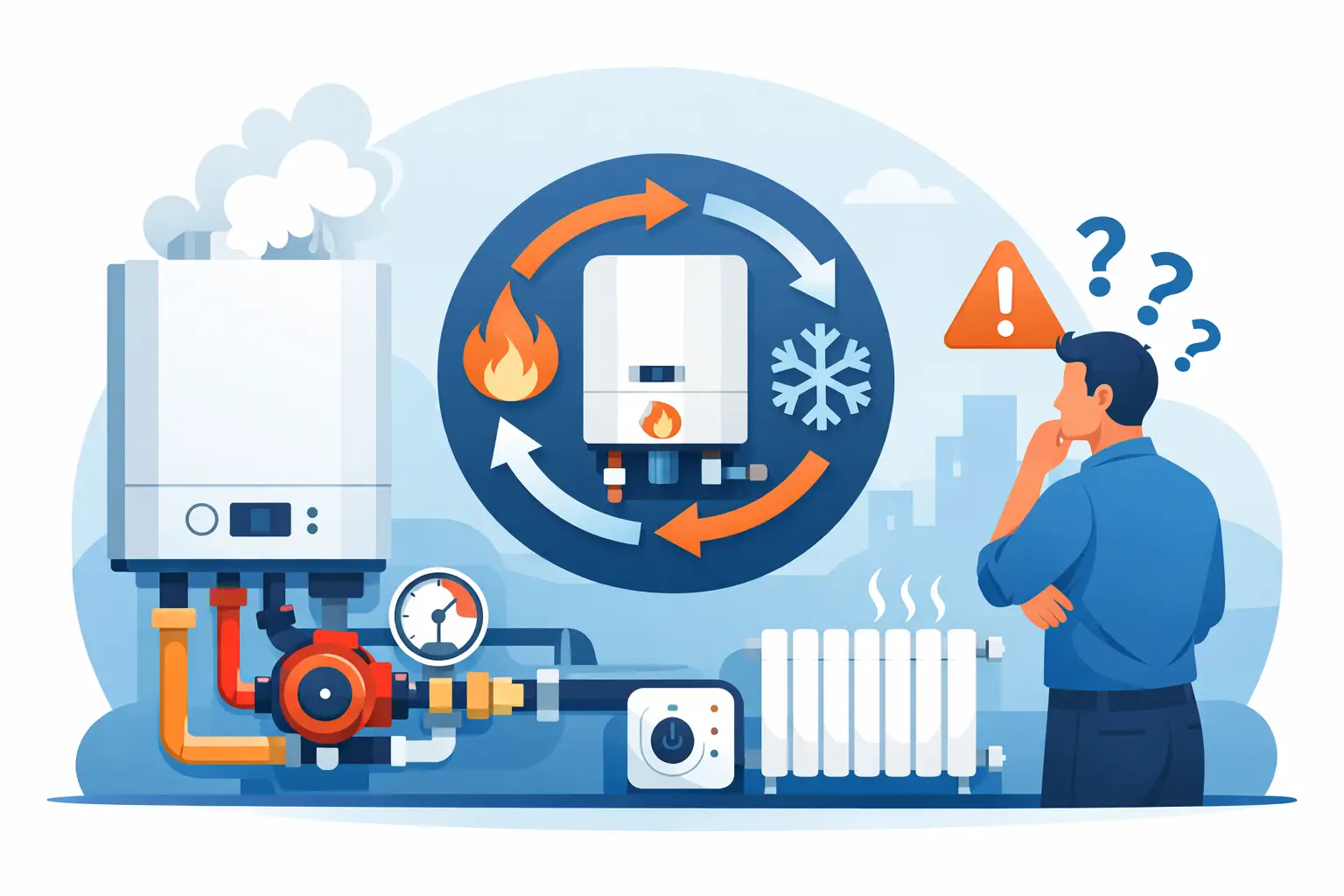
Short cycling is when a boiler turns on and off in frequent, short bursts rather than running steadily until your home reaches the required temperature. You may hear the burner ignite, notice the boiler display becoming active, then find it stops a few minutes later before restarting.
It is not always a fault. Modern boilers modulate their output, meaning they turn the flame down as demand reduces. During mild weather, or when only a small area of a well-insulated property needs heat, some cycling can be normal. The concern is persistent, rapid cycling, particularly if radiators stay lukewarm, rooms do not reach temperature, pressure drops, or the boiler shows a fault code.
The most common boiler short cycling causes
A boiler that is too large for the heating demand
An oversized boiler can produce heat more quickly than the heating system can distribute it. The boiler reaches its target flow temperature, shuts down, then fires again shortly afterwards as the water cools. This is especially common where an older, high-output boiler has remained in place after an extension of controls, insulation improvements or reduced heating demand.
Boiler size is not just about the number of radiators. A correctly specified system considers the property’s heat loss, hot water requirements, radiator output and the way the building is used. Replacing a boiler with a smaller model is not automatically the answer, but an engineer can assess whether the existing appliance is appropriately matched to the property.
Thermostat and control issues
A room thermostat in the wrong location can give misleading readings. If it is near a radiator, fireplace, kitchen appliance, sunny window or draught, it may tell the boiler to stop before the rest of the building is warm. Smart controls and programmable thermostats can also cause unexpected behaviour if schedules, temperature setbacks or hot water settings have been changed.
Check that the thermostat is set to a sensible temperature and is not being warmed directly by another heat source. Avoid turning it up to maximum in an attempt to heat the home faster. The thermostat is a target, not a speed control, and an excessively high setting can encourage inefficient operation.
Restricted water circulation
Your boiler needs a reliable flow of water through the system to carry heat away. If circulation is poor, the water inside the boiler can heat up too quickly and trigger a shutdown for protection. It then cools and restarts, creating the familiar short-cycling pattern.
Restricted circulation may be caused by a failing pump, a blocked filter, partially closed valves, a stuck thermostatic radiator valve or sludge and debris in the pipework. Cold areas at the bottom of radiators, noisy pipework and radiators that heat unevenly often point towards circulation problems. A system clean or powerflush may help in some cases, but it should be recommended after proper assessment rather than used as a default fix.
A dirty or restricted heat exchanger
The heat exchanger transfers heat from the burner to the system water. Limescale, corrosion debris or other contamination can reduce that transfer, allowing the boiler to overheat locally and cut out. This is more likely in systems with poor water quality, inadequate inhibitor protection or a history of leaks and repeated topping up.
This is not a DIY repair. Accessing boiler components requires a Gas Safe registered engineer, who can diagnose the fault safely and advise whether cleaning, repair or replacement is the sensible option.
Low system pressure or a pressure fault
Most sealed central-heating systems operate within a specified pressure range, commonly around 1 to 1.5 bar when cold, although you should always follow your boiler manufacturer’s guidance. If pressure is too low, the boiler may lock out or operate unreliably. High pressure can also cause problems, particularly when the system heats up.
You can look at the pressure gauge or display, but do not keep repressurising the system without finding out why pressure has fallen. A gradual loss may indicate a leak, a faulty expansion vessel, a pressure relief valve issue or air being released from the system. Repeatedly adding fresh water can introduce oxygen and contribute to internal corrosion.
Incorrect boiler temperature settings
If the central-heating flow temperature is set too high for the system, the boiler can reach its limit rapidly and cycle more often. This can be noticeable in smaller homes, properties with oversized radiators or systems with limited open radiator circuits.
The right setting depends on the boiler type, radiator system and controls. Lower flow temperatures can improve the efficiency of a condensing boiler, but setting them too low may mean rooms take too long to warm up. An engineer can help balance comfort, hot water performance and efficient operation rather than relying on a one-setting-fits-all approach.
Closed radiators and bypass problems
Closing too many radiator valves reduces the route available for heated water. When several thermostatic radiator valves shut at once, the boiler may have nowhere to send its heat. A correctly set automatic bypass valve helps maintain safe circulation, but a faulty or poorly adjusted bypass can contribute to cycling and noise.
If the problem began after changing radiator settings, leave several radiators fully open and see whether operation improves. Do not adjust internal boiler settings or bypass valves unless you are competent and have the manufacturer’s instructions. Those changes are best left to a heating professional.
What you can safely check before booking a repair
Start by noting when the cycling happens. Is it only when central heating is running, only when hot water is requested, or during both? Check the boiler display for a fault code, look at the pressure when the system is cold, and make sure the programmer and thermostat are set as intended.
Walk around the property and feel whether radiators are heating consistently. A radiator that is cold at the top may need bleeding, while one that is cold at the bottom may indicate sludge. Only bleed radiators if you are comfortable doing so, and recheck system pressure afterwards. If there is water around the boiler, visible staining, a gas smell, a carbon monoxide alarm activation or a recurring lockout, stop using the appliance and seek professional help promptly.
Avoid removing the boiler casing, attempting to clean the burner, or repeatedly resetting a boiler that keeps locking out. These actions can mask a developing fault and may create a safety risk.
When short cycling needs an engineer
Book an inspection if cycling is frequent, has started suddenly, affects heating performance or is accompanied by banging noises, fault codes, pressure loss or unusually high energy use. A qualified engineer can check combustion, controls, pump performance, flow and return temperatures, system water condition, expansion vessel operation and the condition of key boiler parts.
For landlords and commercial property managers, prompt investigation is particularly worthwhile. A boiler that is still producing some heat can appear serviceable while inefficiency and component wear build in the background. Planned servicing gives an engineer the chance to identify early signs of circulation or control problems before they become a no-heating call-out.
LCA Maintenance supports homeowners and businesses across Bedfordshire and surrounding areas with boiler servicing, repairs and heating diagnostics. Clear fault-finding matters because the right repair depends on the cause, not simply on the symptom.
A boiler should work quietly and predictably in the background. If yours is constantly firing and stopping, arranging a professional check can protect comfort, efficiency and the longer-term reliability of your heating system.