
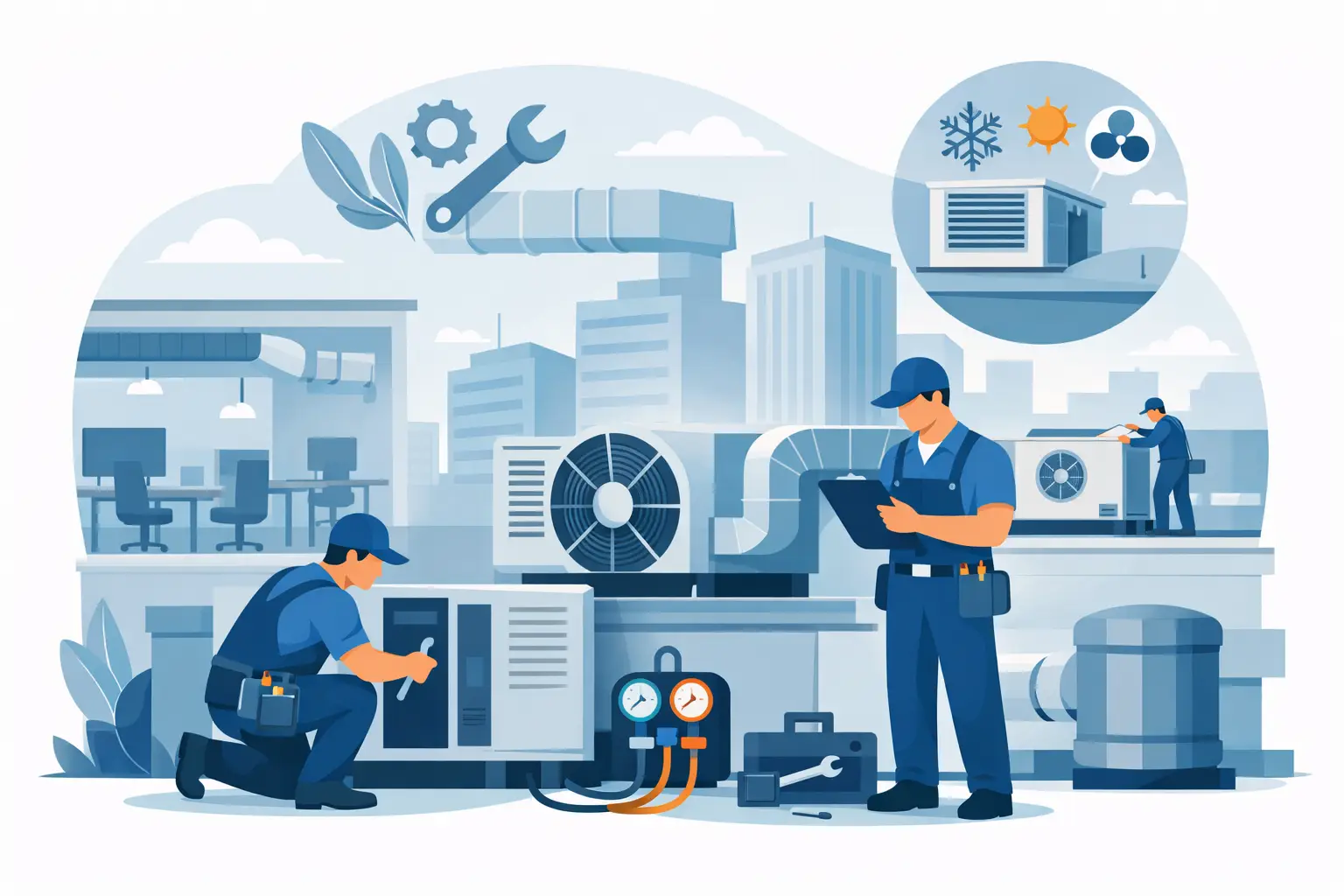
A meeting room that is too warm, a shop floor with poor airflow or an office boiler that fails on the coldest morning can quickly become more than an inconvenience. It affects staff comfort, customer experience, productivity and operating costs. This commercial HVAC maintenance guide explains how planned care protects heating, ventilation, air conditioning and controls before a minor fault turns into an expensive disruption.
Commercial systems work harder than most people realise. They often run for long hours, serve different zones with changing demands and rely on several connected components. A reliable maintenance plan is therefore not just a service visit in the diary. It is a practical way to manage risk, energy use and compliance across your property.
What commercial HVAC maintenance should cover
HVAC means heating, ventilation and air conditioning, but the equipment on a commercial site may also include hot water plant, pumps, pipework, ductwork, extract systems, fan coil units, air handling units, refrigeration equipment, thermostats and building controls. The right scope depends on the building and how it is used.
For example, an office may need close attention to zone controls, filters and ventilation rates, while a restaurant or workshop may place greater demand on extraction, cooling and air quality. A warehouse may have relatively simple heating but high-level equipment that needs safe access and careful inspection. There is no useful one-size-fits-all checklist.
A planned maintenance visit should begin with an assessment of the plant’s condition and operating history. Engineers should then inspect, test, clean and adjust equipment as appropriate, recording faults and recommended remedial work clearly. This gives the responsible person a realistic view of what needs immediate action and what can be budgeted for later.
Start with an accurate asset register
You cannot maintain equipment properly if nobody is certain what is installed. An asset register records each item of plant, its location, make, model, serial number, capacity, age and service history. It should also identify equipment that is critical to operations, such as a server room air conditioning unit or heating plant serving an occupied care setting.
This record makes planned maintenance more efficient because engineers arrive with the right information and can spot recurring faults. It also supports replacement planning. If a unit is becoming unreliable, costly to repair or difficult to source parts for, the business can consider replacement before an emergency dictates the decision.
Keep manuals, commissioning records, warranties, certificates and previous service reports alongside the register. This is particularly valuable when responsibility changes hands between site managers, landlords or managing agents.
Set a maintenance frequency around risk
Many commercial HVAC systems benefit from at least one planned service each year, but high-use, safety-critical or complex equipment may require more frequent attention. Filters in a busy premises, for instance, may need checking far more often than an annual visit. Cooling equipment can also need seasonal preparation before warmer weather increases demand.
The correct interval depends on operating hours, occupancy, the environment, equipment age and manufacturer guidance. Dusty workshops, kitchens, medical settings and premises open seven days a week generally need closer monitoring than a lightly used office.
A practical programme often includes a pre-winter inspection of boilers, pumps and heating controls, followed by a spring or early-summer check of cooling systems. Ventilation and filtration should be reviewed throughout the year, especially where indoor air quality has a direct effect on staff or customers.
The essential checks during planned servicing
A qualified engineer will tailor the visit to the plant, but a thorough commercial maintenance programme commonly addresses these areas:
- Boiler and heating plant performance, combustion checks where applicable, safety devices, pressure, pumps, valves and visible leaks.
- Air conditioning and refrigeration operation, refrigerant circuit condition, condensate drainage, coils, fans, electrical connections and temperature control.
- Ventilation equipment, including filters, belts, motors, ductwork access points, dampers, grilles and airflow performance.
- Controls and electrical components, such as thermostats, sensors, time schedules, actuators, isolators and fault indicators.
Cleaning is not cosmetic work. Blocked filters restrict airflow, dirty coils reduce heat transfer and poorly maintained drains can cause leaks, odours and water damage. Small adjustments to controls can also make a significant difference. It is common to find systems heating and cooling the same space unnecessarily because time schedules or setpoints have not been reviewed.
Use energy data to find hidden waste
Your energy bills and meter data can reveal problems that a single service visit may not. A sudden increase in gas or electricity use, particularly when building use has not changed, deserves investigation. It could point to a failing component, blocked airflow, poor controls, a leak, excessive run times or equipment operating outside its intended range.
Compare consumption against previous seasons and against occupancy where possible. If a building is empty in the evening but plant remains fully operational, adjusting time controls may be one of the quickest savings available. Equally, aggressive temperature settings can increase costs without making occupants more comfortable.
The goal is not to switch systems off indiscriminately. Reducing ventilation or cooling too far can create comfort, moisture or air quality issues. A competent engineer can help balance energy efficiency with the needs of the space and the people using it.
Compliance needs clear records
Commercial heating and cooling maintenance carries responsibilities that should not be left to memory or informal notes. Gas appliances must be inspected and serviced by appropriately qualified Gas Safe registered engineers. Air conditioning and refrigeration equipment may have obligations under F-Gas rules, including leak checks and record keeping, depending on the type and refrigerant charge of the system.
Some air conditioning systems are also subject to TM44 energy inspections. These apply to qualifying systems with an effective rated cooling output over 12kW. The inspection is separate from routine maintenance, although a good maintenance record helps demonstrate how the system is being managed.
The exact duties can vary by plant type, tenancy arrangements and how the building is occupied. Landlords, employers and duty holders should establish who is responsible for each system and retain reports, certificates and repair records in an accessible place. This is not paperwork for its own sake. Good records make it easier to prove checks have been completed and to respond quickly when an issue arises.
Give staff a simple reporting route
Site teams are often the first to notice changes: a new vibration, a warm area near an entrance, unusual smells, dripping from a ceiling cassette or a control panel warning. These signs should be reported promptly, not tolerated until the next planned visit.
Provide a straightforward process for logging faults, including the equipment location, time of day, symptoms and any effect on operations. Photos can help, provided staff do not attempt to open electrical panels or access plant rooms without authorisation. Early reporting can prevent a minor condensate blockage or worn fan belt from becoming a full shutdown.
It is equally useful to tell staff what not to do. Constantly changing thermostats, blocking grilles with furniture or using portable heaters to compensate for a fault can mask the real problem and increase energy use.
Know when repair becomes replacement
Maintenance extends equipment life, but it cannot make ageing plant efficient forever. Repeated breakdowns, rising repair bills, obsolete parts, poor temperature control and high consumption are all signs that replacement may be the better commercial decision.
The cheapest repair is not always the lowest-cost option over the next three to five years. Consider the unit’s condition, expected lifespan, downtime risk, energy performance and whether a replacement could improve controls or zoning. Replacement work also gives an opportunity to correct long-standing design issues, such as equipment that is oversized, poorly located or unable to serve an altered layout.
For businesses across Bedfordshire and the wider South East, LCA Maintenance can support planned servicing, responsive repairs and clear recommendations from fully qualified engineers. The priority should always be to keep essential plant safe, dependable and suited to the way your premises actually operates.
A maintenance plan works best when it is reviewed rather than filed away. After each season, look at call-outs, recurring faults, energy use and feedback from occupants. Those patterns will show where a small adjustment, earlier service visit or targeted upgrade can prevent the next avoidable disruption.